

BIM adoption for mid-sized AEC firms is no longer optional in 2025—it’s a strategic necessity. While many large firms standardized BIM years ago, mid-sized firms face rising pressure from clients, regulators, and competitors to accelerate adoption. Research shows that delaying BIM integration leads to higher costs, missed opportunities, and shrinking relevance in a market rapidly moving toward digital maturity.
Why is BIM adoption urgent for mid-sized AEC firms?
According to the AIA Firm Survey Report 2024, BIM is already standard for 95% of large firms and 88% of mid-sized firms. This means that firms that haven’t embraced BIM are already in the minority—and falling behind fast.
The danger of waiting is twofold:
- Competitive exclusion: Many public contracts and high-value private projects now require BIM deliverables.
- Operational inefficiency: Late adopters struggle with fragmented workflows, higher rework rates, and reduced collaboration efficiency.
Meta-analyses across 13 countries reveal that perceived usefulness and ease of use remain the strongest drivers of BIM adoption, while mimetic pressure—the push to keep up with peers—forces mid-sized firms to adapt or risk obsolescence.
What measurable benefits does BIM bring to mid-sized firms?
The ROI of BIM is proven, especially for firms managing multiple stakeholders and complex deliverables. Case studies show BIM reduces design errors, accelerates delivery timelines, and saves material costs.
For example, one medium-sized UK contractor completed a major commercial project 20% faster, with 30% fewer errors and 15% less material waste by adopting BIM workflows.
At ReviCAD Solutions (BIM Modeling India), our team supported a Global Infrastructure and Connectivity Provider with Revit Family Creation. The adoption of BIM workflows led to improved design accuracy, streamlined collaboration across multiple teams, and significant time savings during project delivery. This case reinforces how outsourcing BIM can help mid-sized firms access expertise without large upfront investment.
How does BIM directly impact profitability and sustainability?
BIM tools are not just about visualization—they drive measurable business impact:
- Cost estimation accuracy: Firms avoid overruns by using real-time data models.
- Conflict resolution savings: Automated clash detection reduces rework.
- Sustainability benefits: Early-stage energy modeling in BIM helps optimize building design for net-zero targets, a growing client requirement in 2025.
At ReviCAD Solutions LLP, we worked on an Educational Campus Renovation in Mexico, where BIM enabled early energy modeling and daylight studies. These insights reduced operational energy consumption and improved compliance with sustainability goals—showing how BIM supports both cost savings and ESG mandates.
What are the risks of delaying BIM adoption?
Delaying adoption is no longer a neutral choice—it actively erodes competitiveness.
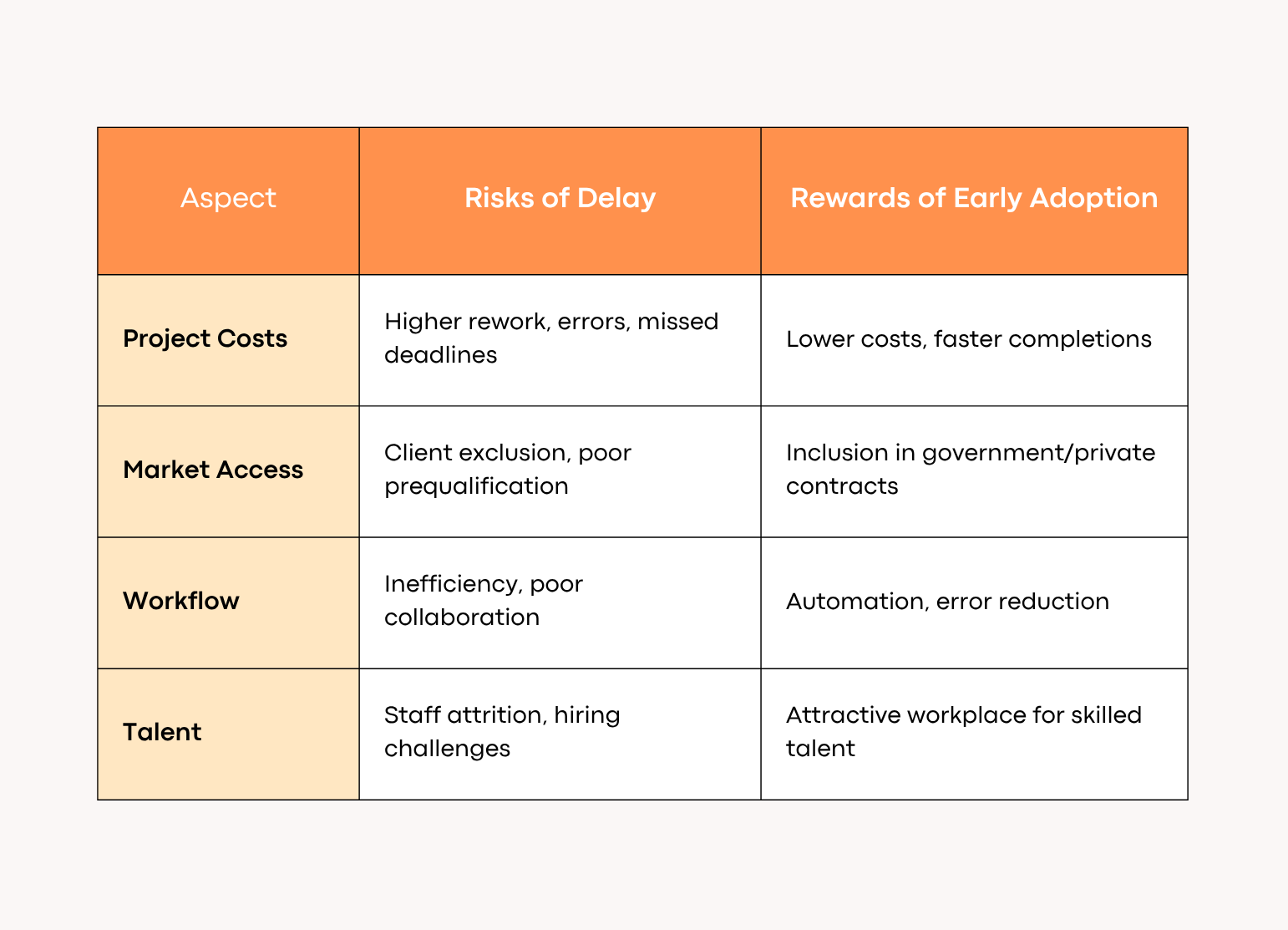
Risks of delay include:
- Higher rework costs due to undetected clashes
- Missed deadlines and penalties in client contracts
- Exclusion from government tenders where BIM is mandated
- Reduced attractiveness for digital-native professionals entering the workforce
Governments in the UK, Spain, Ireland, and beyond now enforce BIM mandates for public projects. Private sector owners are following suit, meaning firms without BIM competence are often not even shortlisted.
Is outsourcing BIM a solution for mid-sized firms?
Yes. For many mid-sized firms, the bottleneck isn’t software—it’s people. Building an in-house BIM team requires high upfront costs, recruitment struggles, and training time.
Outsourcing to specialized firms like ReviCAD Solutions provides a fast, flexible way to integrate BIM expertise without the overhead. Our Point Cloud Processing for a UK Commercial Space project is a prime example—by outsourcing the BIM-heavy detailing work, the client met deadlines and gained an as-built model ready for seamless facilities management.
This hybrid model allows firms to remain lean while still competing for BIM-mandated projects.
What strategies can help firms ensure successful BIM adoption?
Industry experts emphasize that the barrier is often organizational change management, not technology. Successful firms follow three key steps:
- Invest in digital skills – Upskill staff in BIM workflows and model interpretation.
- Set measurable KPIs – Track rework reduction, error detection, and time savings.
- Redesign workflows – Align BIM with collaboration, not just software.
As Dinesh Desai, Technical Director at ReviCAD Solutions, explains:
“The firms that succeed with BIM aren’t necessarily the biggest—they’re the ones willing to rethink processes, set clear ROI metrics, and leverage external partners to accelerate adoption.”
Risks vs Rewards: A Quick Snapshot

Why 2025 is the tipping point
The evidence is overwhelming: mid-sized AEC firms that delay BIM adoption in 2025 risk financial, operational, and competitive decline. With BIM mandates expanding globally and owners choosing partners based on digital maturity, firms must act now to secure long-term relevance.
Whether through in-house upskilling or outsourcing to experts like ReviCAD Solutions, the path forward is clear: invest in BIM today to avoid being locked out tomorrow.
Ready to find out where you stand in your BIM journey? Speak to our experts at ReviCAD Solutions today and get a BIM readiness check tailored for your firm’s unique needs.