
Abstract
Clash detection in BIM is no longer just a coordination step. It acts as design insurance by identifying and resolving hidden conflicts before they impact construction. This article explores how modern clash detection workflows reduce rework, improve buildability, and help project teams move from reactive issue handling to proactive risk prevention.
Most construction issues do not start on-site.
They start much earlier, quietly embedded in drawings, hidden between disciplines, and often overlooked because everything looks fine in isolation.
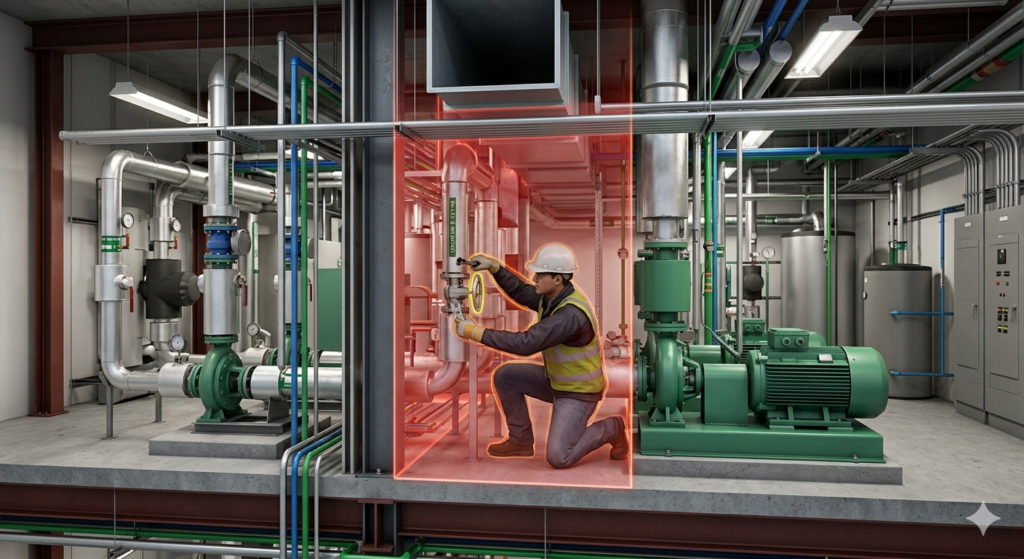
It is only when these designs come together in the real world that problems begin to surface. A duct suddenly runs through a beam. A cable tray blocks access to critical equipment. A maintenance zone simply does not exist.
At that point, the conversation shifts instantly from design to damage control.
Over the years, I have come to see clash detection not just as a coordination step, but as something far more strategic. It acts as a kind of design insurance, a way to uncover and resolve risks before they become delays, cost overruns, or difficult on-site conversations.
Over the years, I’ve come to see clash detection not just as a coordination step, but as something far more strategic. It acts as a kind of design insurance, a way to uncover and resolve risks before they turn into delays, cost overruns, or difficult conversations on-site.
Why “Insurance” Is the Right Way to Think About It
When teams talk about clash detection, the focus is usually on identifying conflicts. In reality, the value is not in finding problems. It is in protecting decisions before they become expensive to change.
In a coordinated BIM environment, we bring architectural, structural, and MEP models together and test them as a single system. What we are really asking is simple. Will this actually work when built?
That question sounds obvious, but it is surprisingly difficult to answer without proper coordination.
I remember a comment I came across recently from a site engineer on X. He said, “Catching a beam to duct conflict in the model costs you 20 minutes. Catching it during erection costs the project thousands.” That line stayed with me because it perfectly captures the gap between digital intent and physical reality.
Clash detection helps close that gap.
The Shift Happening in the Industry
Not too long ago, clash detection was treated as a periodic task. Models were reviewed at intervals, reports were generated, and coordination meetings followed. It worked, but it was reactive.
Today, the shift is clearly toward something more continuous and intelligent.
With platforms like Autodesk® Navisworks, Autodesk® Revit, and Autodesk® Construction Cloud, teams are no longer waiting for clashes to accumulate. Conflicts are identified almost as soon as they are introduced.
What is even more interesting is how teams are starting to prioritize issues. Not every clash deserves the same attention. A minor routing overlap is very different from a structural conflict or a safety concern. The more mature teams focus on impact first, resolving what truly matters before getting lost in volume.
There is also a growing conversation in the industry about moving from clash detection to clash prevention. You can see this reflected in BIM communities where professionals are pushing for shared modeling standards, real-time collaboration, and better upfront planning so clashes do not happen in the first place.
That is the direction things are heading.
Where It Makes the Biggest Difference
Clash detection proves its value most clearly in complex environments, particularly where multiple systems compete for limited space.
MEP Coordination

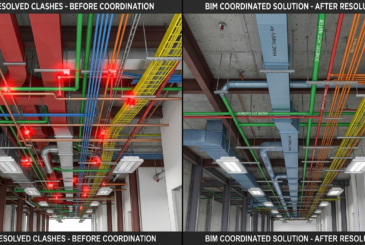
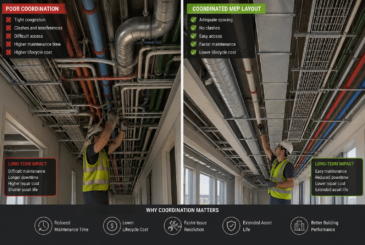
If there is one place where coordination can make or break a project, it is MEP.
High-Complexity Projects
In environments like hospitals, data centers, or large infrastructure projects, the margin for error is extremely small.
Systems are tightly packed, dependencies are high, and downtime is not an option. In such cases, clash detection becomes less about coordination and more about risk management.
You are not just checking geometry. You are ensuring that the building will function exactly as intended.
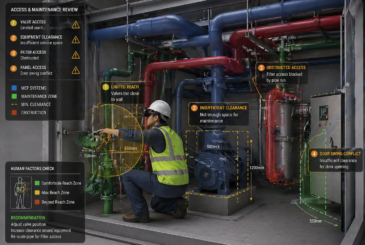
Beyond Screens: Seeing the Problem Before It Exists
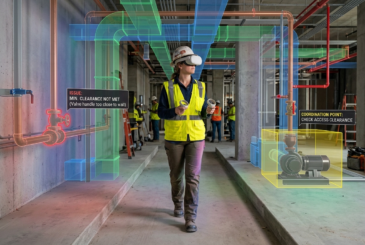
Where Things Often Go Wrong
Despite all the tools and technology available, many teams still struggle with implementation.
One common issue is what I call clash overload. When rules are too aggressive, the system flags everything, including minor and irrelevant overlaps. The result is noise, and when everything looks like a problem, nothing gets solved effectively.
Another challenge is ownership. When clash detection is treated as a task for the BIM team alone, coordination breaks down. Real value comes when architects, engineers, and contractors are all part of the process, continuously refining the design together.
There is also a tendency to ignore soft clashes such as clearances, tolerances, and access zones. These are often the issues that create the biggest challenges after construction.
Finally, there is the issue of detection without resolution. Logging clashes is straightforward. Resolving them, tracking them, and ensuring accountability is where real project success lies.
A Better Way to Look at It
I often encourage clients to rethink how they evaluate clash detection.
Instead of asking, “How many clashes did we find?” ask, “How much risk have we removed?”
That is the real outcome.
When done right, clash detection does not just improve coordination. It builds confidence. It allows teams to move forward knowing that the design has been tested, refined, and validated before it reaches site.
How We Approach It at ReviCAD
At ReviCAD, we do not treat clash detection as a standalone deliverable. It is part of a larger coordination ecosystem.
Our focus is always on making the model buildable, not just visually correct. This involves setting up the right rules, filtering out unnecessary noise, prioritizing critical issues, and ensuring that every identified clash is followed through to resolution.
More importantly, we stay involved throughout the coordination cycle. That is where the real value lies, not in running the test, but in what happens after.
Construction projects rarely fail because of one major mistake.
More often, it is the accumulation of small, unresolved issues, things that could have been addressed early but were not.
Clash detection allows you to solve those problems when they are still manageable.
That is why I see it as design insurance.
Because by the time the problem reaches site, it is no longer a design decision. It becomes a cost.
Final Takeaway
Clash detection is often seen as a technical process, but its impact is far more strategic.
It gives teams the ability to test decisions before they become permanent, to identify risks before they become expensive, and to move forward with greater clarity.
The real shift is not in the tools being used, but in how teams think about coordination. When clash detection is treated as design insurance rather than a checklist activity, it changes the way projects are delivered.
And in an industry where small issues can quickly turn into major setbacks, that shift makes all the difference.
Want to reduce coordination risks before they reach your site?
Let’s explore how a structured BIM coordination approach can help you deliver with greater clarity and confidence.