

What decision-makers actually look for — and why most BIM vendors still get it wrong
In 2025–2026, owners and EPCs evaluate BIM vendors less on software skills and more on delivery maturity, information management, and risk control.
The strongest vendors demonstrate:
- Proven experience in similar project types
- A project-specific Proposal BIM Execution Plan (BEP) aligned to Owner Project Requirements
- Clear information exchange, QA, and validation workflows
- Transparent commercial structures with defined scope and change control
Vendors relying on generic BEPs, unnamed teams, or low pricing without governance are often disqualified early. Modern BIM procurement is a risk-management decision, not a modeling comparison.
Written for owners, EPCs, and procurement teams responsible for selecting BIM delivery partners.
Why BIM vendor evaluation has fundamentally changed
Choosing a BIM vendor in 2026 is no longer about finding a team that “knows Revit.”
Most owners and EPCs have already experienced projects where BIM models were delivered, yet coordination failed, data was inconsistent, and handover information was unusable. The lesson has been clear: modeling capability alone does not guarantee project success.
Today, BIM vendor evaluation has evolved into a delivery-risk and information-governance exercise. Owners are asking a more mature question:
Can this partner reliably manage coordination, information, and accountability across the project lifecycle?
This shift has reshaped how BIM vendors are shortlisted, scored, and awarded work.
How do owners and EPCs evaluate BIM vendors in 2025–2026?
Owners and EPCs evaluate BIM vendors based on delivery capability, information management maturity, and commercial risk control. Software proficiency alone is no longer sufficient. Vendors are assessed on how well they translate owner requirements into governed, predictable BIM delivery.
Across sectors, evaluations consistently fall into three core pillars.

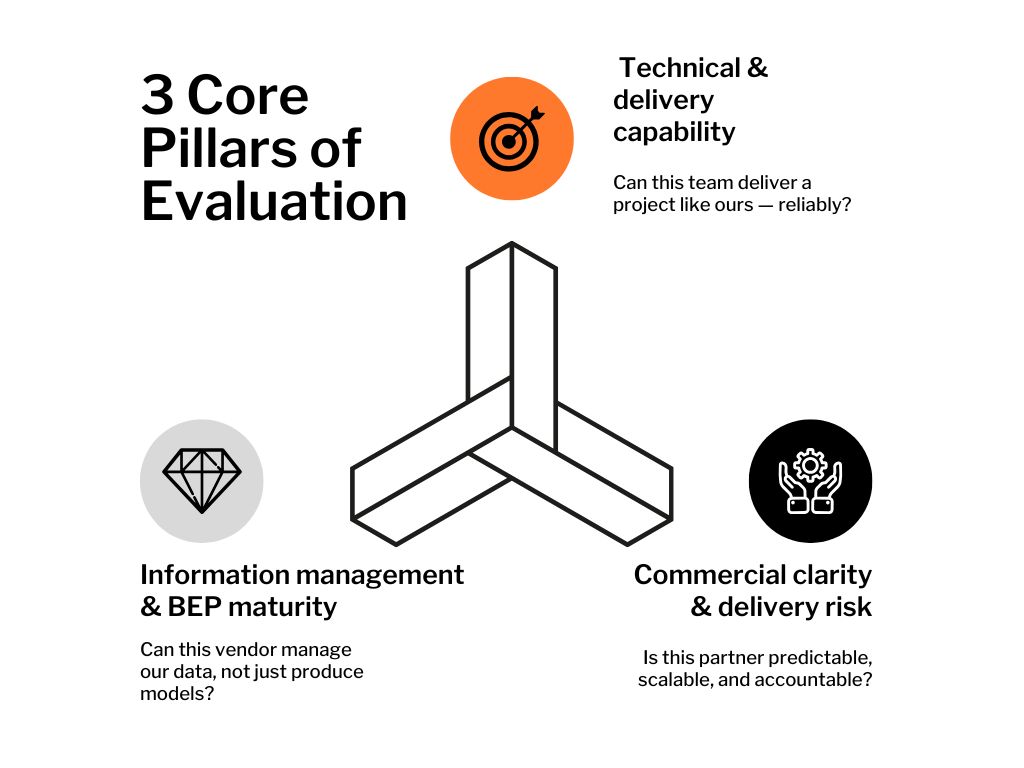
Pillar 1: Technical & delivery capability
Can this team deliver a project like ours — reliably?
Owners are not impressed by long lists of tools or generic BIM credentials. They look for relevance and proof of execution.
What decision-makers examine
- Experience on similar asset types and scales (infrastructure, healthcare, commercial, industrial)
- Understanding of how BIM will be used, not just modeled:
- Design coordination and clash resolution
- Constructability and sequencing support
- Quantity extraction and cost alignment
- Asset data preparation for handover
- Named delivery resources, including:
- Lead BIM Manager
- Discipline coordinators
- Quality reviewers
What strong vendors do differently
They show how coordination works in practice — workflows, review cycles, and real examples — instead of relying on capability statements alone.
Pillar 2: Information management & BEP maturity
Can this vendor manage our data, not just produce models?
This is where many BIM vendors lose procurement confidence.
Owners increasingly treat BIM as an information management process, not a design service. As a result, the Proposal-stage BIM Execution Plan (BEP) carries significant weight during evaluation.
What is a Proposal BIM Execution Plan (BEP)?
A Proposal BIM Execution Plan is a project-specific document submitted during procurement that explains how a BIM vendor will meet Owner Project Requirements, manage information exchanges, ensure quality control, and reduce delivery risk before contract award.
What owners look for in a Proposal BEP
- Clear linkage between project objectives and BIM uses
- Defined roles, responsibilities, and approval authority
- Information exchange schedules (what, when, who, format)
- QA, validation, and coordination checkpoints
- Transparent assumptions, risks, and exclusions
Why is a generic BIM Execution Plan a red flag?
A generic BEP indicates that the vendor has not aligned their approach to the specific project. In modern BIM procurement, this often signals low execution maturity and is a common reason for technical disqualification.
Pillar 3: Commercial clarity & delivery risk
Is this partner predictable, scalable, and accountable?
Price is no longer viewed in isolation.
What procurement teams evaluate
- Pricing structured by:
- Project phase
- Defined deliverables
- Specific BIM uses
- Clearly stated scope boundaries
- Formal change-management process
- Capacity and continuity planning (including offshore or backup teams)
- Data security, confidentiality, and IP protection
Do owners evaluate BIM vendors based on price alone?
No. In most procurements, technical capability and BEP quality are assessed before commercial bids. Low pricing without staffing clarity or governance is typically viewed as a delivery risk, not a cost advantage.
How owners typically score BIM vendors
Most owners and EPCs use a weighted evaluation framework similar to this:

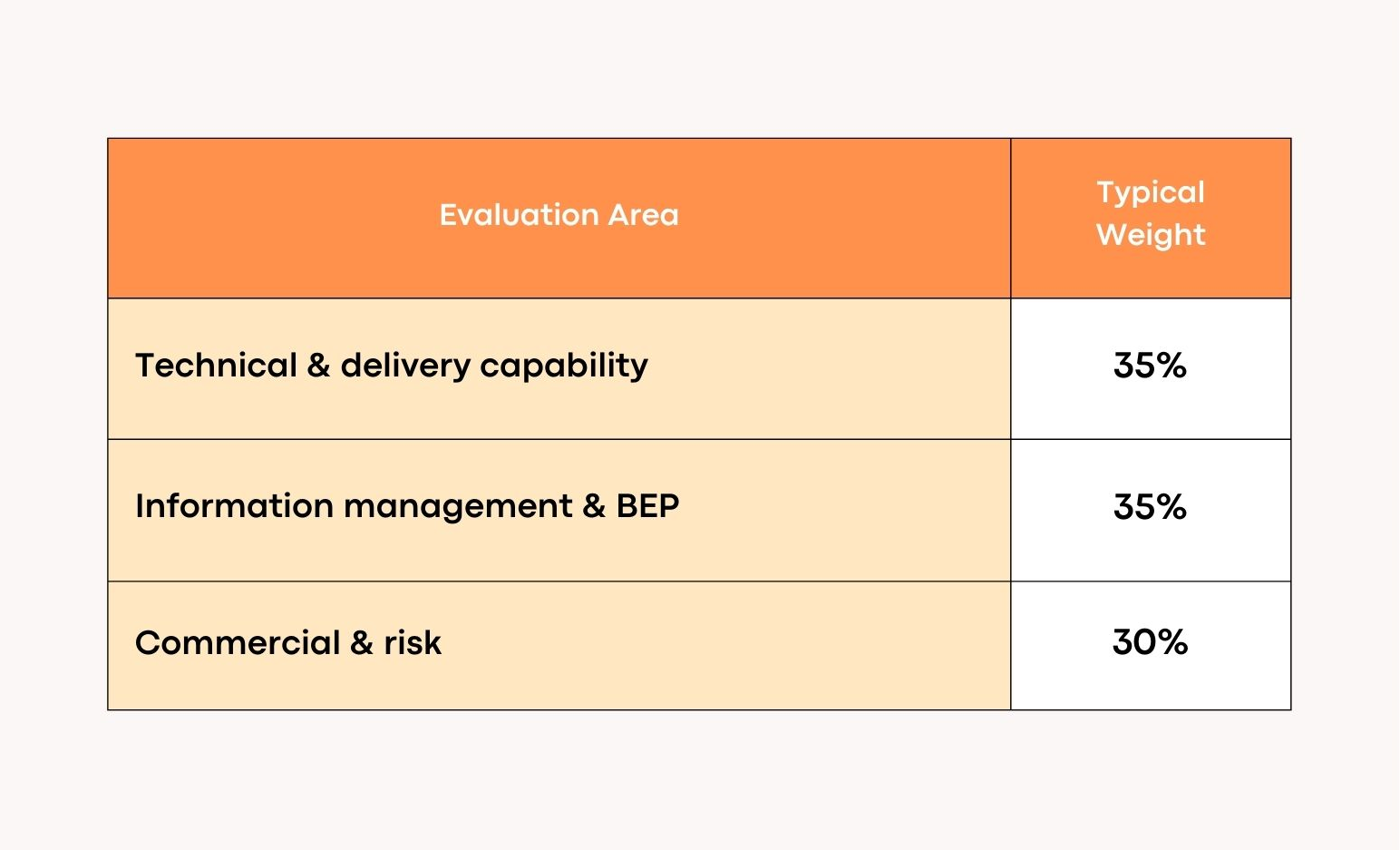
In many cases, commercial proposals are only opened after technical qualification.
Minimum RFP requirements owners now expect
To reduce downstream issues, mature procurement teams increasingly mandate:
- Project-specific Proposal BEP
- Named delivery team with defined roles
- Sample deliverables or anonymized model extracts
- QA and coordination methodology
- Information handover strategy (IFC, asset data, FM readiness)
- Relevant client references
Vendors unable to meet these requirements early rarely perform well during execution.
Common red flags during BIM vendor evaluation
Experienced evaluators proceed with caution when vendors:
- Submit generic, non-project-specific BEPs
- Avoid naming delivery resources
- Cannot demonstrate QA or validation workflows
- Focus heavily on software instead of outcomes
- Offer low pricing without scope or staffing clarity
These are often early indicators of delivery risk disguised as efficiency.
After selection: how owners protect BIM outcomes
Leading owners now formalize BIM governance by:
- Making the approved Project BEP contractual
- Linking payments to validated deliverables
- Tracking BIM KPIs throughout execution
- Holding retention until successful information handover
This turns BIM from a coordination aid into a controlled delivery system.
Key takeaways for owners & EPCs
- BIM vendor selection is a risk-management decision, not a software comparison
- Proposal-stage BIM Execution Plans are now mandatory, not optional
- Information governance matters as much as modeling accuracy
- Low-cost bids without delivery clarity often increase long-term risk
- The strongest BIM partners demonstrate outcomes, not just capability lists
In 2026, the best BIM vendors are not defined by how fast they model — but by how well they:
- Translate owner objectives into execution plans
- Govern information across project stages
- Reduce delivery and operational risk
For owners and EPCs, a structured evaluation process is no longer optional. It is the difference between BIM as overhead and BIM as insurance.
Preparing to evaluate BIM vendors? Request a sample Proposal BEP or a vendor evaluation checklist to benchmark your procurement process.