

How to decide what to keep in-house — and what to outsource without losing quality or control
There is no universal right answer to insourcing or outsourcing BIM. In 2025–2026, owners and EPCs make this decision based on risk exposure, control requirements, cost predictability, and project scale — not ideology.
- Insource BIM when control, real-time coordination, and IP sensitivity are critical
- Outsource BIM when scalability, cost efficiency, and delivery speed matter more
- Most successful organizations adopt a hybrid BIM model, keeping strategy and governance in-house while outsourcing execution
This article provides a practical decision framework to help owners choose the right BIM delivery model.
Why the in-source vs. outsource BIM debate still exists
BIM outsourcing is no longer controversial — it is common.
Yet many owners still struggle with the decision because:
- Poor outsourcing experiences created trust issues
- Insourcing increased fixed costs without improving outcomes
- Hybrid models were attempted without governance
The real issue is not where BIM is done — it is how control, accountability, and information flow are managed.
How do owners decide whether to insource or outsource BIM?
Owners evaluate BIM sourcing models based on four primary factors:
- Delivery risk
- Cost structure
- Level of control required
- Internal BIM maturity
The decision should change by project phase, asset type, and scale — not be fixed company-wide.
Option 1: Insourcing BIM
When control outweighs cost efficiency
Where insourcing works best
Insourcing BIM is most effective when:
- Projects are complex or highly sensitive
- Real-time coordination with design and construction teams is critical
- BIM outputs directly influence safety, approvals, or regulated deliverables
- The organization already has strong BIM leadership
Advantages of insourcing BIM
- Maximum control over workflows and priorities
- Immediate access to project teams
- Better protection of IP and sensitive data
- Faster design feedback loops
Limitations owners often underestimate
- High fixed costs (salaries, software, training, attrition)
- Difficulty scaling resources up or down
- Risk of skill stagnation if exposure is limited to one project type
Insourcing increases control — but also locks in cost and capacity.
Option 2: Outsourcing BIM
When scalability and cost predictability matter
Where outsourcing works best
Outsourcing BIM is effective when:
- Projects require rapid scaling
- BIM tasks are execution-heavy rather than strategic
- Cost predictability is a priority
- Internal teams need relief during peak loads
Advantages of outsourcing BIM
- Access to specialized skills on demand
- Lower and more flexible cost structures
- Faster ramp-up for large or multi-project programs
- Reduced internal management overhead
Common outsourcing risks
- Loss of visibility if governance is weak
- Communication delays without defined workflows
- Quality inconsistency if QA is not enforced
- Overdependence on vendors without clear accountability
Most outsourcing failures are governance failures, not vendor failures.
Cost comparison: insource vs outsource BIM (simplified)

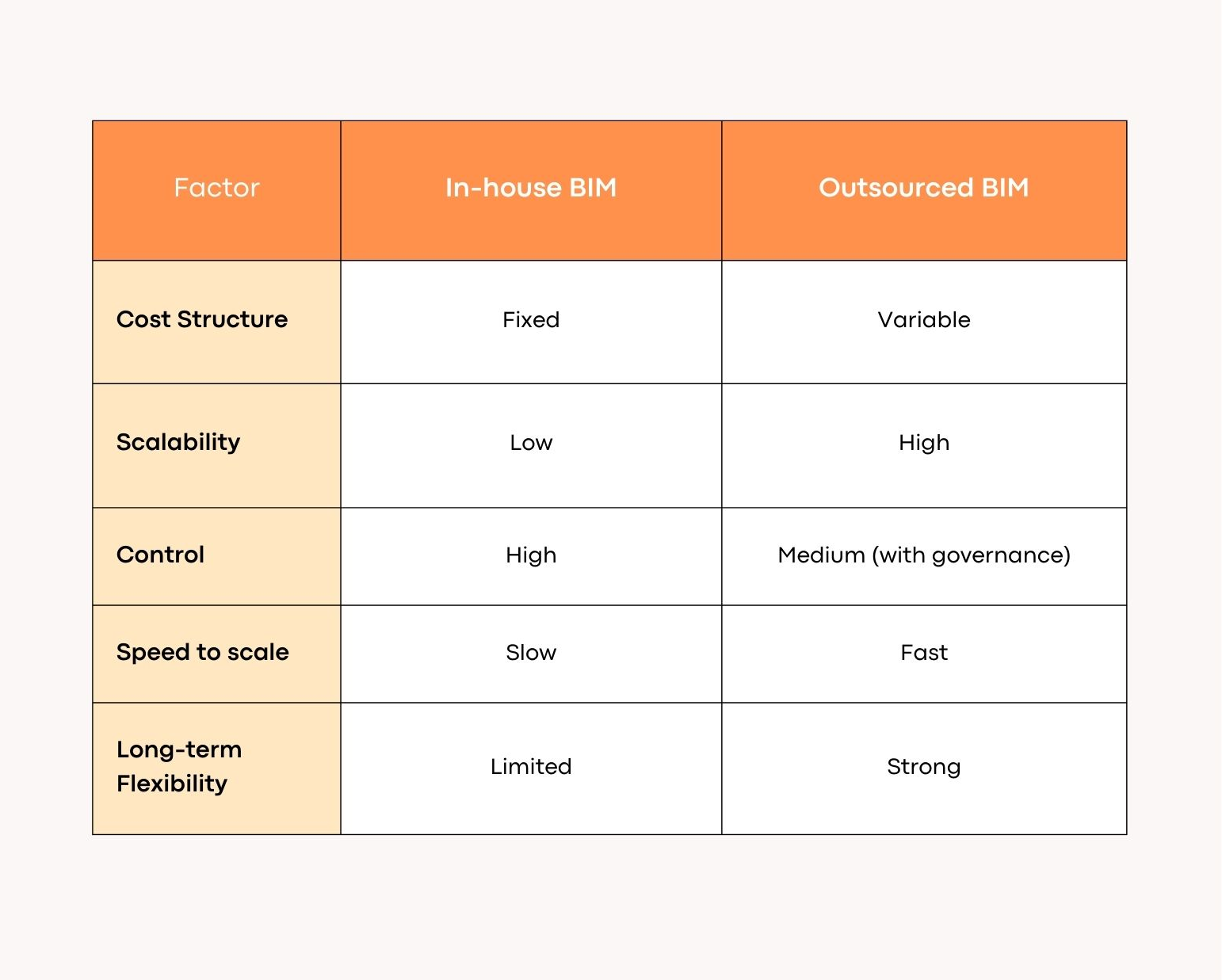
Cost alone should never be the deciding factor — risk-adjusted cost should.
The hybrid BIM model (what most mature owners use)
The most effective organizations do not choose sides.
They:
- Keep BIM strategy, standards, and governance in-house
- Outsource model production, coordination support, and documentation
- Retain approval authority internally
- Use Proposal BEPs and KPIs to govern external teams
This model preserves control while unlocking scale.
What should always remain in-house?
Regardless of sourcing strategy, owners should retain:
- BIM standards and templates
- Information requirements (OPR/EIR)
- Final approval authority
- Quality benchmarks and acceptance criteria
Outsourcing execution does not mean outsourcing accountability.
Red flags when choosing a BIM sourcing model
- Insourcing without a long-term resource plan
- Outsourcing without a project-specific BEP
- Treating BIM vendors as drafting resources only
- No defined ownership of information quality
These mistakes increase cost and reduce confidence — regardless of model.
Key takeaways for owners
- BIM sourcing is a strategic decision, not an operational shortcut
- Insourcing increases control but locks in cost
- Outsourcing improves scalability but requires governance
- Hybrid models deliver the best balance of risk, cost, and control
- Governance determines success — not geography
The question is no longer “Should we outsource BIM?”
It is “Which BIM responsibilities should we retain — and which can be delivered better through partners?”
Owners who answer this clearly build resilient, scalable BIM delivery models.
Evaluating your BIM sourcing strategy? Request a hybrid BIM governance checklist to benchmark your current approach.