
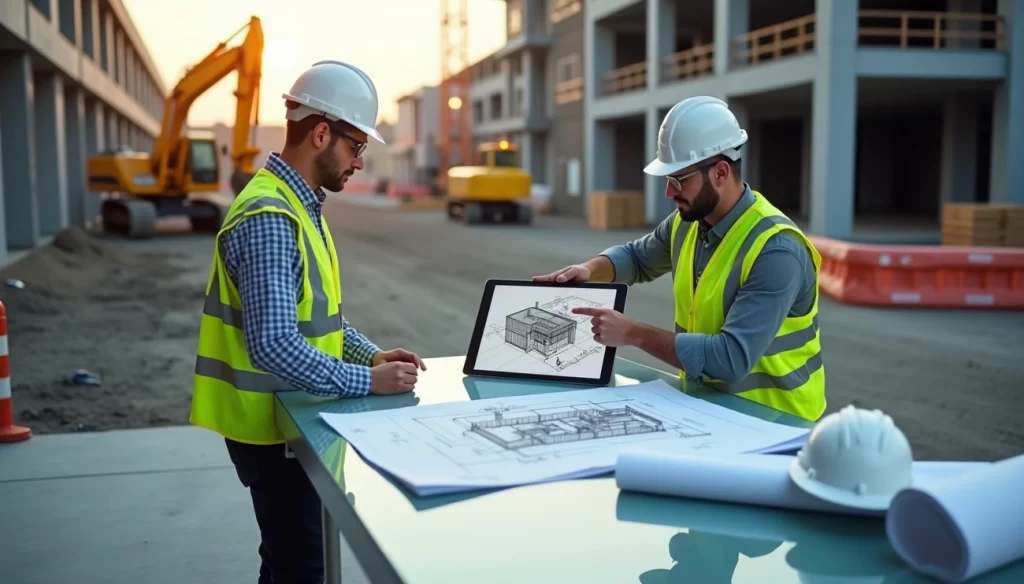
Winning a construction tender is about more than just offering the lowest cost. Owners and contractors are increasingly evaluated on quality, capability, and delivery confidence. In this competitive environment, Building Information Modeling (BIM) is proving to be a decisive differentiator.
Recent research from Saudi Arabia, a hub of mega-projects such as NEOM and The Line, shows that adopting a BIM strategy can raise the probability of winning tenders by as much as 9.4% in quality-based selection and 5.5% in cost-based selection. While these numbers may seem modest, they often represent the fine margin between winning and losing high-value projects.
This article explores how BIM improves tender success rates, the measurable impact shown by industry case studies, and how owners and contractors can leverage BIM to strengthen their bids.
Why BIM matters in tendering
Tendering has traditionally been driven by cost-first decision-making. However, this approach often results in project delays, rework, and compromised quality. As global markets demand faster, safer, and more sustainable projects, evaluation criteria have expanded to include:
- Design quality & constructability
- Risk mitigation strategies
- Lifecycle and operational efficiency
- Collaboration & stakeholder communication
BIM addresses each of these areas. It goes beyond 3D modeling to integrate time (4D), cost (5D), and lifecycle data (6D/7D). When contractors embed BIM in their proposals, they showcase an ability to deliver projects with fewer errors, better coordination, and predictable outcomes.
The case study: Saudi Arabia’s tendering landscape
The referenced case study analyzed tender selection criteria in Saudi Arabia by surveying 85 experienced engineers, consultants, and BIM managers across 32 firms.
Key insights included:
- Communication advantage: BIM boosted communication effectiveness among contractors, subcontractors, and owners by 25%, the highest single benefit.
- Stronger cost control: Proposals using BIM showed up to 12% better accuracy in cost estimation and improved cost-control confidence.
- Reduced change orders: BIM-enabled tenders indicated a 10% reduction in expected change orders, signaling smoother delivery.
- Lifecycle value: Maintenance and operational costs could be reduced by 9%, demonstrating long-term benefits for owners.
- Overall probability uplift: Contractors using BIM in proposals increased their winning probability by 9.42% (quality-based selection) and 5.5% (cost-based selection).
Why this matters for contractors
For contractors, tendering is a numbers game. Margins are thin, and owners often have dozens of bidders to evaluate.
- Differentiation – Stand out by showing digital workflows, clash-free designs, and proactive coordination.
- Credibility – Use previous BIM-enabled projects as proof points.
- Risk reduction – Demonstrate fewer disputes, fewer RFIs, and faster execution.
- Alignment with global mandates – In markets like the UK, BIM Level 2 is already mandatory; others (including Saudi Arabia and India) are rapidly moving toward BIM-based procurement.
Why this matters for owners
Owners want confidence and clarity when awarding contracts. A contractor who uses BIM provides:
- Transparent cost forecasting – linked directly to model data.
- Predictable timelines – via 4D scheduling simulations.
- Quality assurance – digital validation against codes and requirements.
- Operational value – structured data that supports facility management long after construction ends.
For owners, choosing a BIM-ready contractor is not just about winning the tender—it’s about ensuring the project’s long-term success.
Turning BIM into a winning tender strategy
1. Highlight BIM-Driven Value in Bid Proposals
Don’t just state “we use BIM.” Instead, demonstrate tangible benefits:
- Show a clash-detection report proving design accuracy.
- Include 4D visualizations of project sequencing.
- Present lifecycle cost simulations.
2. Align BIM Strategy with Tender Selection Criteria
The case study mapped BIM advantages against typical evaluation factors such as cost, schedule, quality, and communication. Contractors can explicitly show how BIM enhances each criterion.
3. Tailor BIM to Project Delivery Methods (PDMs)
- In Design–Bid–Build (DBB) projects, emphasize how BIM supports shop drawings, quantity take-offs, and accurate BOQs.
- In Integrated Project Delivery (IPD), highlight BIM as the central collaboration platform connecting all stakeholders.
4. Use Data and Case Studies as Proof
Owners and evaluators value evidence over claims. Contractors should present:
- Before/after metrics from past projects (e.g., 15% reduction in RFIs).
- Industry benchmarks such as the 9.4% tender-winning probability increase demonstrated in the Saudi case study.
The ReviCAD advantage: Helping owners and contractors win with BIM
At ReviCAD Solutions, we’ve seen firsthand how early BIM adoption transforms tender outcomes. Our expertise spans across BIM modeling, MEP coordination, clash detection, and scan-to-BIM services, enabling both contractors and owners to leverage BIM strategically during the tendering process.
Here’s how we add value:
For Contractors
- Bid-Ready BIM Models: We prepare high-quality models with accurate quantity take-offs, sequencing, and cost data that strengthen proposals.
- Clash-Free Confidence: By resolving design conflicts before submission, we help contractors showcase a risk-free, construction-ready plan.
- Competitive Edge: Our BIM deliverables highlight innovation and capability, giving contractors the credibility owners look for.
For Owners
- BIM Tender Requirements: We help owners define clear BIM deliverable expectations in RFPs, ensuring fair evaluation and long-term project value.
- Quality Assurance Frameworks: ReviCAD provides QA/QC checks so owners can validate the accuracy of contractor BIM submissions.
- Lifecycle Advantage: Beyond construction, we structure BIM data for operations and facility management, maximizing long-term asset ROI.
Download
How to Win More Construction Bids Using BIM – A Practical Guide
This blog gave you insights, but our free guide takes it further—with checklists, visuals, and a proven framework to help you win more bids.
In essence, ReviCAD bridges the gap between tendering strategy and BIM execution. Whether it’s helping a contractor demonstrate capability or enabling an owner to demand higher standards, our role is to ensure BIM isn’t just a buzzword in the proposal—it’s a measurable advantage that wins bids and delivers real value.
BIM is no longer just a design tool—it is a business-winning strategy. Contractors who integrate BIM into tender proposals gain measurable advantages in evaluation, cost confidence, and owner trust.
The Saudi Arabian case study underscores that even a 5–9% increase in winning probability can make the difference between securing and losing multimillion-dollar projects. For owners, choosing BIM-enabled contractors ensures higher quality, lower lifecycle costs, and fewer risks.
In short: BIM doesn’t just build better projects—it helps win them. And with partners like ReviCAD Solutions, that advantage is within reach.
References:
-
Majzoub, M., & Eweda, A. (2021). Probability of Winning the Tender When Proposing Using BIM Strategy: A Case Study in Saudi Arabia. Buildings, 11(7), 306. https://doi.org/10.3390/buildings11070306
-
Additional insights adapted from global BIM adoption studies and industry best practices.