In today’s world, the architecture, engineering, and construction (AEC) industry is under increasing pressure to reduce its environmental footprint. From stricter carbon targets to the growing demand for energy-efficient, healthy buildings — it’s clear that business as usual won’t meet tomorrow’s sustainability goals.
It’s no longer enough to rely on better materials or solar panels alone. Achieving true sustainability requires a shift in how we design, build, and operate our built environment.
That’s where Building Information Modeling (BIM) comes in. Once known simply as a 3D modeling tool, BIM has evolved into the digital backbone of sustainable construction — an intelligent ecosystem that combines design, performance data, and lifecycle insights to help AEC teams deliver measurable environmental impact.
BIM as the Engine Behind Net-Zero Goals
When it comes to net-zero design, BIM acts as more than a visualization platform — it’s a data-rich, decision-making environment. It enables architects, engineers, and contractors to align design intent with performance outcomes, ensuring that sustainability is integrated from concept through construction and beyond.
As one sustainability strategist puts it, BIM is no longer just about geometry — it’s about combining data, analytics, and collaboration to achieve low-carbon design outcomes. With BIM, design teams can simulate, test, and optimize a building’s environmental performance before a single foundation is laid.
Sustainability experts also describe BIM as a “mindset for precision.” Tools like Autodesk Revit®, Insight, and IESVE allow real-time simulation of parameters such as thermal efficiency, daylighting, orientation, and solar gain. This means sustainability isn’t a last-minute add-on — it’s baked into the design from the start.
In essence, BIM helps transform buildings from passive energy consumers into active contributors to climate goals.
BIM and the Sustainability Revolution
The synergy between digital technology and sustainable construction is reshaping global markets.
- The net-zero energy buildings market is projected to grow from USD 60.2 billion in 2025 to USD 416.6 billion by 2037, at an impressive CAGR of 17.2%.
- Another forecast estimates growth from USD 41.7 billion in 2024 to USD 192.1 billion by 2033, driven by government regulations, green financing, and corporate climate pledges.
- The BIM software market itself is expected to nearly double — from USD 9.9 billion in 2025 to USD 19 billion by 2030, a CAGR of 13.9%.
These statistics make one thing clear: BIM and sustainability are not parallel tracks — they’re converging into a single movement. From digital twins to renewable energy modeling and sustainability certifications (LEED, BREEAM, WELL), BIM now provides a data-backed foundation for climate-positive construction.
Key Challenges in BIM-Driven Sustainability
Despite its clear potential, the path to net-zero through BIM is not without obstacles.
1. Resistance to Change: Traditional contractors and firms often resist adopting new digital workflows. A lack of awareness and digital maturity slows transformation and prevents organizations from realizing BIM’s full sustainability potential.
2. Upfront Implementation Costs: BIM adoption involves initial expenses for software licensing, training, and setup. For smaller firms, these can appear prohibitive — though, over time, the returns from reduced waste, optimized energy performance, and fewer reworks often far outweigh the investment.
3. Data Interoperability: Seamless collaboration remains challenging. Discrepancies between BIM platforms and sustainability analysis tools (like energy simulation or carbon accounting software) can limit project-wide integration.
4. Skills Gap: Sustainability-focused BIM demands expertise beyond modeling — including life cycle analysis (LCA), embodied carbon tracking, and energy simulation. The shortage of professionals skilled in both BIM and sustainability disciplines remains one of the industry’s biggest gaps.
BIM Solutions and Best Practices for Sustainable Design
To address these challenges, the industry is developing smarter, more integrated BIM workflows that connect people, data, and processes in powerful new ways.
1. Integrated Design Workflows: Using BIM-driven energy simulations early in the design phase allows project teams to forecast energy consumption, thermal comfort, and daylight performance with high accuracy. Tools such as EnergyPlus, Revit Insight, and IESVE empower designers to test different configurations — enabling data-informed decisions that improve long-term energy efficiency.
2. Lifecycle Carbon Tracking: By integrating LCA tools within BIM environments, teams can calculate embodied and operational carbon consistently throughout the project lifecycle — from design and material selection to operation and demolition. This approach helps projects stay compliant with global sustainability frameworks while providing a transparent record of environmental performance.
3. Regulatory Compliance via BIM: Governments and public-sector organizations increasingly recognize BIM as a compliance tool for sustainability mandates. Initiatives by the EU, UK, and US GSA are already incorporating BIM-based sustainability reporting into public project requirements, reinforcing accountability across the supply chain.
4. Collaborative Digital Twins: The integration of BIM with IoT sensors and digital twin technology allows for continuous performance monitoring after project completion. Building operators can track energy consumption, predict maintenance needs, and optimize systems — ensuring the building stays efficient long after handover.
Quantifiable Impact of BIM on Sustainability
The measurable benefits of BIM-driven sustainability are well documented:
- 20–30% improvement in energy efficiency, achieved by optimizing building orientation, glazing ratios, and HVAC performance.
- Up to 25% reduction in construction waste, thanks to accurate material quantification and 4D sequencing.
- 15–20% lifecycle cost savings, resulting from reduced rework, improved asset management, and lower energy bills.
Beyond these metrics, BIM fosters transparency, collaboration, and accountability — qualities essential to delivering truly sustainable buildings.
Success Stories: BIM in Action
1. Silver Oak Winery, California
The LEED Platinum-certified winery used BIM to plan construction phases, minimize material waste, and improve HVAC efficiency. The result: a beautiful, high-performance facility that blends craftsmanship with sustainability. Read full story
2. Surat Diamond Bourse, India
One of the world’s largest office complexes, the Surat Diamond Bourse relied on BIM-based coordination to manage thousands of design elements efficiently. The project achieved enhanced energy performance and reduced construction rework, demonstrating how large-scale BIM implementation supports sustainability even in high-complexity builds. Read full story
3. Casa Piedra Blanca, Mexico
This residential project leveraged BIM to align design with local climate and materials. BIM simulations helped reduce overall energy demand while preserving cultural and architectural identity. Read full story
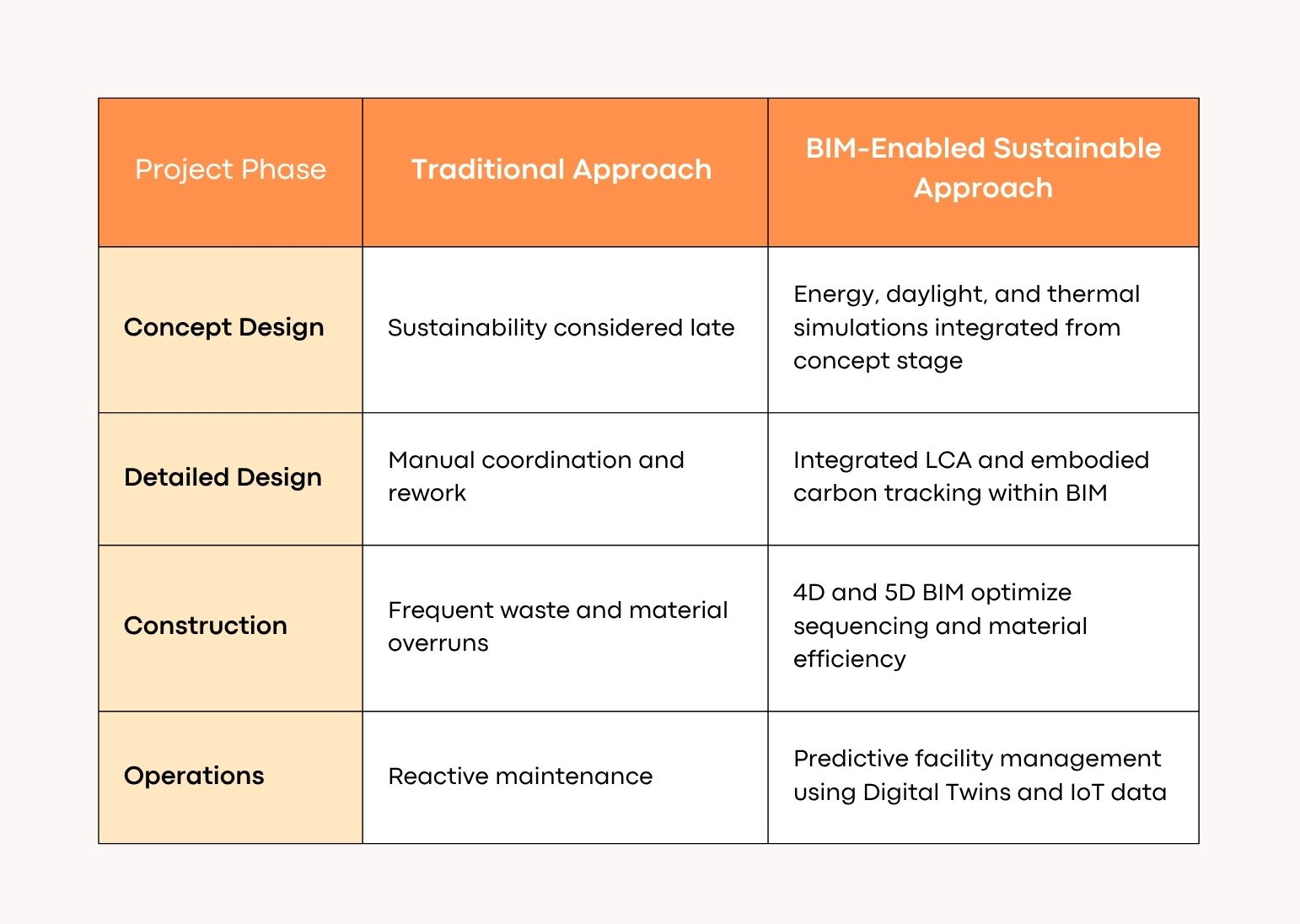
How BIM Transforms Every Stage of Sustainable Construction
The Road Ahead: Toward Regenerative Design
The future of BIM and sustainability extends beyond net-zero — toward regenerative construction, where buildings actively restore the environment. As AI, IoT, and digital twins continue to evolve, BIM platforms are becoming more intelligent, predictive, and adaptive.
Imagine a building that learns over time — automatically balancing energy loads, adjusting lighting, or optimizing HVAC settings based on occupancy and weather. With BIM at the core of this transformation, the vision of self-optimizing, climate-positive buildings is closer than ever.
Building Smarter, Building Greener
BIM’s role in achieving net-zero and sustainable buildings goes far beyond technology — it represents a shift in mindset. It empowers AEC professionals to design with intent, build with precision, and operate with accountability.
By merging creativity with data intelligence, BIM ensures sustainability isn’t just a compliance requirement — it’s a measurable outcome.
As global sustainability standards tighten, one thing is clear: BIM isn’t just shaping the future of construction; it’s shaping the future of our planet.
Ready to make your next project net-zero ready?
Discover how ReviCAD Solutions’ BIM expertise empowers AEC teams to design, simulate, and deliver sustainable projects—efficiently and confidently. Get in touch